


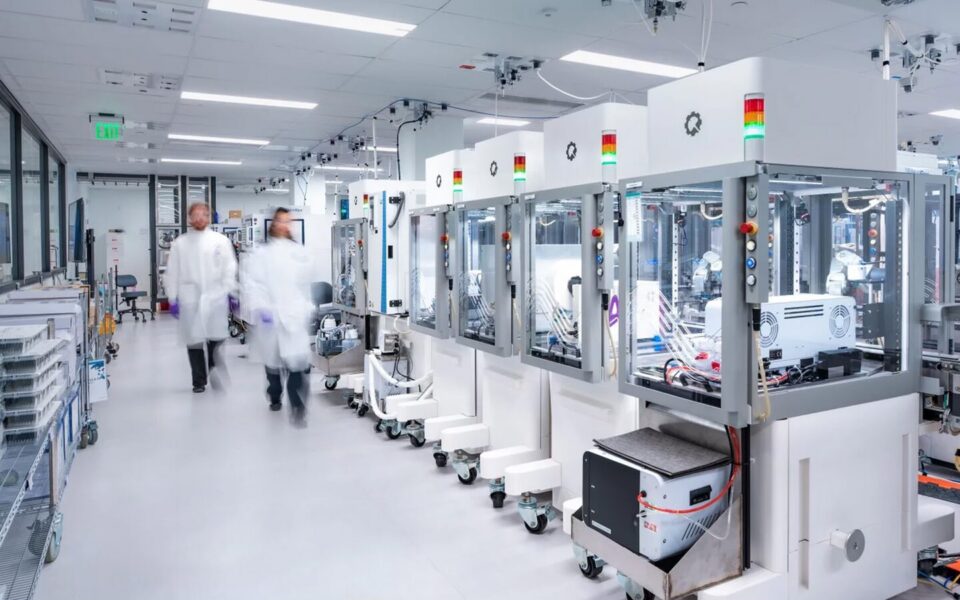
AI-designed experiments run by robots hint at a new approach to biology
Researchers at OpenAI and Ginkgo Bioworks showed that an AI model working with an autonomous lab can design and iterate real biology experiments at unprecedented speed.
OpenAI’s GPT can summarize research papers and make predictions—but can it do science? Can it generate hypotheses, design experiments, interpret results and iterate? Last summer researchers at OpenAI and Ginkgo Bioworks, a company that designs and installs autonomous, robot-run labs, decided to find out.
Though artificial intelligence systems have posted high scores in math, physics and computer science, biology is harder to measure, says Joy Jiao, who leads life sciences research at OpenAI. “For something like ‘design the optimal experiment,’ there’s no right answer. It’s what we call a hard-hard problem: it’s hard to generate a solution, and it’s also really hard to verify.” That led the team to have AI design experiments using superfolder green fluorescent protein (sfGFP), an engineered jellyfish protein that is a common benchmark because it provides a fast, unambiguous signal: it glows green.
While OpenAI’s GPT-5 provided the experimental designs, Ginkgo Bioworks provided what its co-founder and CEO Jason Kelly calls the “Waymo” of biology: an automated lab system where researchers set objective and the AI does the driving. The autonomous robotic lab can rapidly process experiments and operate without constant human oversight.