


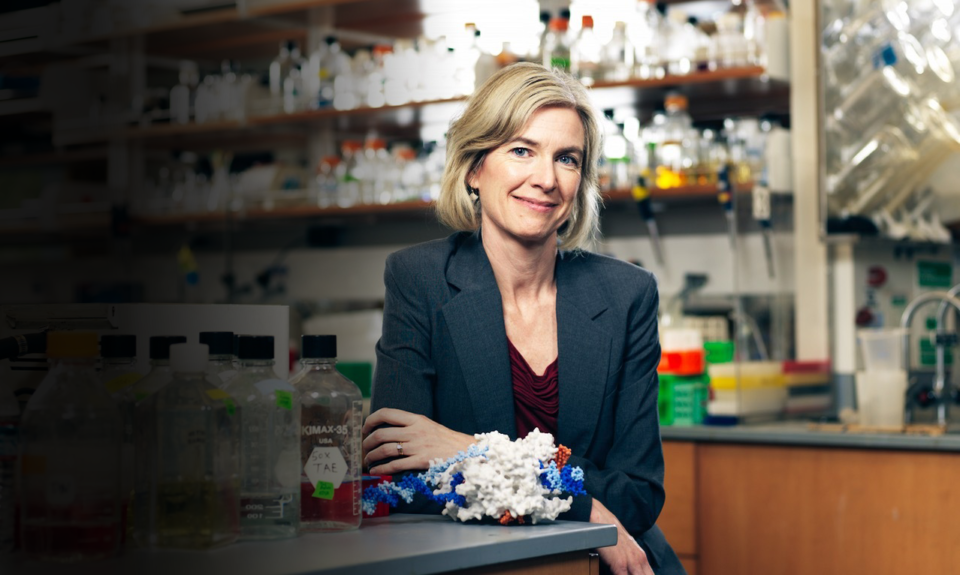
Jennifer Doudna
Focus
CRISPR
Services
Public Relations
Global Media and Speaking
Thought Leadership
Special Projects
For more than 10 years Thermal has supported Dr. Jennifer Doudna: her research, platform, and argument for how CRISPR should be responsibly developed, deployed, and the industry that has grown out of the technology she co-invented.
Challenge
A technology only impacts people if they trust it and can access it. When Dr. Doudna and Dr. Emmanuelle Charpentier published the CRISPR-Cas9 method in 2012, CRISPR genome editing was a specialist craft practiced in a few laboratories.
Turning it into medicines, crops, and climate tools would take more than proving it worked at the bench. It needed a public that understood what it was, regulators willing to govern it without strangling it, investors willing to fund a decade of unproven science, and a global research community that agreed on the lines nobody crosses.
All of that is reputational, and reputations are fragile. Gene therapy lost the better part of a decade after a single patient death in 1999. In November 2018 a researcher in Shenzhen announced he had edited the genomes of twin girls, and CRISPR arrived at the same kind of moment. What the technology became after that was not inevitable.
Approach
Thermal has supported Dr. Doudna across every public dimension of her science since 2016. The fundamental research at UC Berkeley and the Innovative Genomics Institute.
The platform, from the TED stage to essays in TIME, Nature, WIRED, and The Atlantic.
The crises: the 2018 embryo experiment, and the 2020 testing collapse, when IGI stood up a clinical laboratory in a matter of weeks. Her case that CRISPR must be governed responsibly and reach the patients with the greatest need rather than the greatest means.
The awards, the lectures, the stages. The briefings with members of Congress, the United Nations Secretary-General, and health authorities abroad. The companies built on her science. The Nobel Prize.
One idea organizes all of it. CRISPR’s reputation is an asset the entire field draws on, and every public moment either adds to it or spends it. We have handled Dr. Doudna’s on that basis for years, because what is at stake in each one is not a placement. It is whether a technology that can change the human condition is supported and trusted enough to be allowed to.
Impact
In October 2020, Dr. Doudna was awarded the Nobel Prize in Chemistry along with Dr. Emmanuelle Charpentier “for the development of a method for genome editing.In October 2020 Dr. Doudna and Dr. Charpentier received the Nobel Prize in Chemistry for developing a method for genome editing. In 2026 the American Chemical Society awarded her the Priestley Medal, its highest honor. Her CRISPR patents hold in more than 30 countries.
The technology reached patients. The first CRISPR medicine won regulatory approval in 2023. In 2025 an infant named KJ received a therapy designed for his mutation alone, built in six months at IGI with Children’s Hospital of Philadelphia and Danaher, the first person anywhere treated with a gene editor made for him.
The CRISPR economy is now measurable. Thirty-one companies have come out of the Innovative Genomics Institute, worth roughly $9 billion together and employing more than 2,500 people, built largely on philanthropic and public money. Dr. Doudna is a cofounder of seven of them. In February 2026 Forbes gave her a feature on her plan to raise $1 billion so that the institute can keep seeding the next thirty.
Beyond medicine, CRISPR crops are in field trials: rice and tomato bred for climate resilience, with sorghum and chickpea to follow. IGI has trained scientists to use the technology in India, Brazil, and across Africa, on the principle that the people who need it most should not be the last to get it.
And the guardrails held. The international consensus against heritable human genome editing that Dr. Doudna helped build has not broken, through the 2018 experiment and through every venture since that has tried to reopen the question. Her voice on it now runs in her own words, in TIME, in WIRED’s World annual three years running, in The Atlantic, and in Nature. In April 2026 she carried the argument to primetime in CNN’s Kara Swisher Wants to Live Forever followed in July 2026 by a Bloomberg Originals with Emily Chang discussion on the AI in drug discovery and development.
Behind those moments are several hundred more. For over 10 years Thermal has managed and evaluated countless of opportunities for Dr. Doudna: interview requests, speaking invitations, editorial commissions, documentary approaches, and government and institutional briefings. The volume has not slowed, and the quality of what arrives at the top of it keeps rising. Ten years of standing in the field means the openings that come to her now are ones that did not exist to be asked for in 2016.
The next argument is already here. CRISPR and artificial intelligence are the two most consequential technologies of this moment and they are converging: models that design edits, predict their effects, and compress the years between identifying a mutation and treating it. Dr. Doudna’s byline in The Atlantic opened that conversation. Thermal is building it into the next phase of her platform, because whoever explains what these two technologies do together will shape what society allows them to do.
A technology this powerful could as easily have been set back a decade by its first scandal. Supporting the scientist who made sure it wasn’t has been the privilege of this firm’s decade. The more consequential decade is the one starting now.