


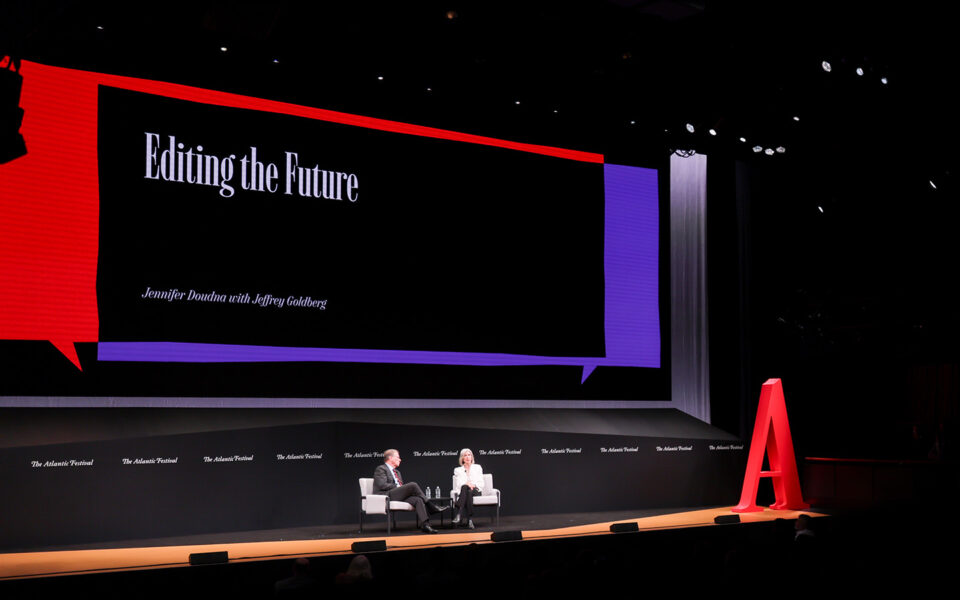
The Atlantic Festival 2025
At The Atlantic Festival 2025, we facilitated a conversation with CRISPR pioneer and Nobel Laureate Jennifer Doudna on the defining challenge for gene editing’s next chapter: transforming breakthrough science into accessible, scalable therapies that can reach everyone who needs them.
The Baby KJ Case: Proof of Concept
The most striking example came from Children’s Hospital of Philadelphia. A baby born with a rare metabolic disease — unable to digest protein — received a personalized CRISPR therapy designed, manufactured, and FDA-approved in real time. Nine months later, he’s home with his family, living normally.
This case demonstrates what’s now technically possible: rapid diagnosis to customized genetic correction. The model works. The question is how to make it work at scale.
The $2 Million Problem
With FDA approval of CRISPR therapies for sickle cell disease and dozens of patients treated — including Victoria Gray, the first U.S. patient — the technology has proven itself curative. But at roughly $2 million per patient for a one-time treatment, accessibility remains the critical barrier.
As Dr. Doudna emphasized, this price point excludes most people globally who could benefit. The focus now shifts from proving the science to engineering the delivery systems, manufacturing processes, and regulatory pathways that can drive costs down and availability up.
Agriculture: The Underreported CRISPR Story
While medical applications dominate headlines, agricultural deployments are already delivering impact. Drought-resistant rice is in fields across South America. Enhanced tomatoes with improved nutritional profiles are reaching consumers. Companies are developing crops with 5-10 precise genetic changes that increase productivity without additional nutrient requirements.
CRISPR’s precision advantage matters here: it creates targeted improvements without the random changes of traditional breeding methods. The technology is proving itself across sectors, not just in clinics.
The Regulatory and Trust Challenge
Dr. Doudna maintained her measured stance on germline editing: while future applications may be possible, current knowledge gaps make it unsafe for any use today. She called for transparent frameworks to be ready when the science advances — a position that balances innovation with caution.
On scientific trust, she pushed back against vaccine skepticism and misinformation, emphasizing data quality and the need for discernment about sources. Her defense of NIH funding was direct: “For every dollar of NIH funding, we get $50 back.”
What’s Next
The vision for 5-10 years: a clear pipeline from rare disease diagnosis to personalized therapy at accessible cost. Dr. Doudna’s new San Francisco center aims to pioneer this model and scale it across medical centers.
The technology works. Now comes the harder work of making it work for everyone.
“I think there’s an opportunity to expand the way we are treating rare disease. The market says that it’s small but if you add up all the people affected by rare disease, it’s actually not a small number. What I’d like to see us do over the next 5 to 10 years — I hope it doesn’t take 10 — is to have a clear pipeline to diagnosing a rare disease, to creating a therapy that’s going to be the appropriate treatment for that person, and then getting it to them. And doing it in a cost-effective way.”
Dr. Jennifer Doudna – The Atlantic Festival 2025
Learn more about our work with Dr. Doudna here and the Innovative Genomics Institute here.